|
|
Posterior tibial tendonitis/insufficiency treatment: trigger point massage
Even though your diagnosis may be Posterior Tibial Tendonitis, (or Tendonosis,
or Tendon Insufficiency), the muscle will be involved, and Trigger Point Massage
of the Tibialis posterior muscle itself will be of great benefit...
(<<< Diagram: Posterior Tibial and Neighbouring Trigger Point Knots, with their patterns of pain referral)
|

About the Author...

Why donate?
PayPal Membership No Longer Required!
|

Table of Contents
Page 1: Tibialis Posterior Tendonitis Rehab: Introduction
Page 2: Posterior Tibial Insufficiency Treatment (1): Leg Realignment
Page 3: Posterior Tibial Insufficiency Treatment (2): Exercises
Page 4: Posterior Tibial Tendonitis Treatment: Trigger Point Massage
(< You are here)
Page 5: Posterior Tibial Insufficiency Treatment
(4): Postural Realignment Made Easy!
Contents, this page
Introduction to trigger point self massage
How to locate your tibialis posterior trigger point
massage the trigger point!
modern medical imaging leads to tunnel vision
References
Introduction to trigger point self massage
Trigger points are mysterious and very
often painful and distressing. Indeed, it has been stated that Trigger Points are
responsible for 80% of Musculoskeletal pain! Although a handful of doctors have
devoted their lives to the study of trigger point diagnosis and therapy and it is
a powerful branch of medical science(1), very few doctors have sufficient training
to be able to consider trigger points as part of the diagnostic workup. Some
(although unfortunately not all) physiotherapists are exceptionally good at
trigger point therapy. But just because trigger points are mysterious and doctors
as a whole do not understand them does not mean that we cannot self treat through
trigger point self massage. Here is as description of trigger point massage of the
Posterior tibial muscle. Before I start, I need to warn you that thumb pressure
on a trigger point knot in a muscle is painful. You will have to take my word
for it that this is good pain! - See reference (1) for exceptionally good information
on trigger point massage. The more sensitive the trigger point is to the pressure
of your thumb, the more likely it is that you will benefit from trigger point massage.
How to Locate Your Tibialis Posterior Trigger Point
1. Locate the sore spot in the muscle!
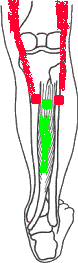
The location of the trigger point in the Tibialis posterior is shown in diagram 28.
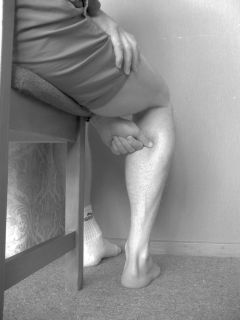
- Locate it by sitting in a chair as shown (picture 29).
- Use the width of your hand to measure the distance from below the crease in your knee (picture 30).
- The Tibialis trigger point is in the center line (the green spot in diagram 28).
When you press on the Posterior Tibial trigger point, it is painful under the thumb.
You will also feel a deep aching pain below the trigger point (green area).
Neighbouring trigger points are located in the Soleus and Gastrocnemius muscles
either side of the Tibialis trigger point. The red areas depict the pain patterns
that these points "trigger" in the author's leg. Be aware that patterns do differ
a little between different people. The Posterior Tibial trigger point may also send
a zone of "aching and tingling" to the front of the lower leg.
This is shown in Picture 31 below.
Variations in the pain pattern:
- If you suffer posterior tibial "tendonitis", expect to feel trigger point pain in the
Posterior tibial tendon on the inside of your ankle and foot(1).
- The calf muscle pain depicted in diagram 28 may extend down into the Achilles
tendon, and even around the heel(1).
|
|
Picture 28: Location of trigger points
Picture 29: Thumb placed on the Tibialis posterior trigger point.
Picture 30: Your thumb should be placed one hand breadth below the
hamstrings, in the center of the calf.
|
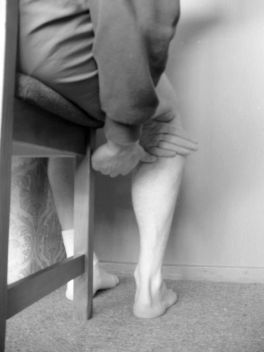
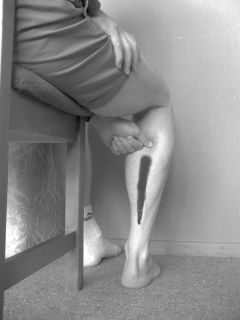
Picture 31:
Thumbs applied to trigger point massage of the Posterior Tibial Muscle. The dark
streak indicates where the author feels pain and tingling upon Tibialis posterior trigger point massage.
|
|
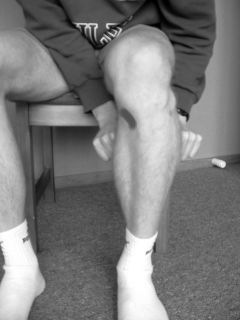
Picture 32:
Two thumbs applied to trigger point massage of the Posterior Tibial Muscle. The dark
streak indicates where the author feels pain upon Tibialis posterior trigger point massage.
|
Massage the trigger point!
There are various possibilities for applying massage treatment to a trigger point -
most of which are somewhat painful. I shall describe what I find to be the most comfortable for me. Here goes!
- Monitor the level of pain on a scale of 1 to 10. Don't exceed a pain level
above 7. Ask yourself, "would I willingly inflict this therapeutic pain on myself
tomorrow"? If the answer is "no!", then you are pressing too hard!
- Apply thumb pressure (one or two thumbs) for 5 to 10 seconds, back off for 2-3
seconds, and reapply. Repeat for up to a minute at a time.
- Once you have gotten comfortable with steady state thumb pressure, you may wish
to move your thumbs in small circles to confirm that you are directly over the trigger point.
When you are finished, walk around a little. A standard recommendation after this
sort of therapy is to drink plenty of water and to walk frequently and gently over
the next two to three days. In other words, don't sit for too long. You can repeat
trigger point massage a few times per day, for a number of days, whenever you need it.
Don't overdo it though. It's better to be consistent than overly aggressive.
Modern medical imaging leads to tunnel vision
Modern Medical Science places a heavy emphasis on imaging techniques (X-rays, MRI's etc.)
to look for lesions. Medical dogma runs thus: If the part is inflamed, the lesion will
be called "itis" (as for example Posterior tibial tendonitis). If there are degenerative
signs in the painful part, the lesion shall be called "osis", as for example "tibial
tendonosis". If there is pain and medical imaging cannot identify a lesion, the condition
shall be called "syndrome". These terms are merely locally descriptive. Imaging is
very useful but you need to step back and see the whole body, (indeed, you
need to see the whole person in his or her environment). Only the big picture will identify
the actual cause and solution. This kind of diagnostic tunnel vision makes it
easy to miss the obvious. There is a strong danger of performing lesion based surgery
first, and posture and movement therapy last.
A good example of tunneled
vision is to be found in the review article on Tibialis-posterior tendonitis by Owen Anderson (ref. 2).
Owen is a gifted writer. There is no insufficiency in his analytical
or writing skills. But the tunnel visioned dogma in his
reference list lets him down - you can't be any better than the information that is available to you.
In summary: Certainly look for the lesion. But also stand back and get the big picture!
References
- 1. Clair Davies: The Trigger Point Therapy Workbook
- 2. Owen Anderson: Tibialis-posterior tendinitis: here's how to avoid tibialis-posterior tendinitis
and iliotibial band syndrome http://www.sportsinjurybulletin.com/archive/tibialis-tendinitis.html
- 3. S. Jari, N. Roberts and J. Barrie: "Non-surgical management of tibialis posterior
insufficiency" Foot and Ankle Surgery Volume 8 Page 197 - September 2002
- Myerson MS, Badekas A, Schon LC: "Treatment of stage II posterior tibial
tendon deficiency with flexor digitorum longus tendon transfer and calcaneal
osteotomy." Foot Ankle Int. 2004 Jul;25(7):445-50.
|
|
|
Return to top...
Tibialis-posterior Rehabilitation © Bruce Thomson EasyVigour Project
|