|
|
|---|
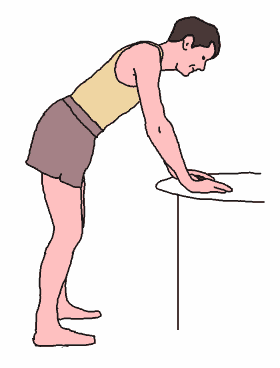
Lumbar Flexion-Extension Test - Start Position:-
- While keeping your whole spine lengthening - neither flexed, nor extended - place your hands palm down on a table top.
- Keep your knees slightly flexed.
Relax and find the most comfortable neutral positioning for your lumbar spine.
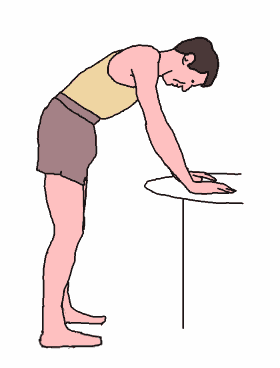
(Action: Exploring Lumbar Flexion):-
- Slowly flex (or arch) your back until pain warns you to go no further, and stop at the point of pain.
- Hold the position three breathes.
- Take note of the type of pain. Did you notice a dull increase, or was it a sharp stabbing pain?
- Ease back to your neutral start position.
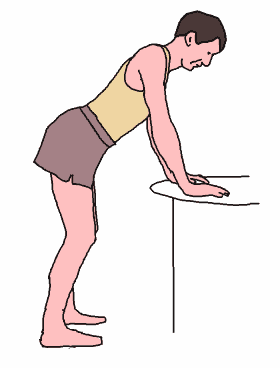
(Action: Exploring Lumbar Extension):-
- Slowly extend your back (make a hammock shape) until pain warns you to go no further.
- Hold the position three breathes,
- Take note of the type of pain. Did you notice a dull increase, or was it a sharp stabbing pain?
- Ease back to your neutral start position.
Gently and slowly repeat the procedures until you identify which movement
(flexion or extension) is the most restricted & causes the most or the sharpest pain.
(low back pain physical diagnosis scroll right>>>...)
|
Pictures: Lumbar Flexion & Extension Test
|
Start Position:-
|
Exploring Lumbar Flexion:-
|
What this exercise does-
- Identifies which movement most efficiently triggers your painful symptoms -
a very useful piece of information if you want to avoid further pain and damage!
- Relaxes your back slightly.
|
Exploring Lumbar Extension:
|
- Gives you encouragement that your back still has some small range of movement.
|
(low back pain physical diagnosis © Bruce Thomson, EasyVigour Project
scroll up^^^^....)
|
Comments - The Concept of Directional Susceptibility of Movement, or “DSM".
Physiotherapist Shirley Sahrmann defines DSM thus:-
"The impairments of soft tissues induced by repeated movements and sustained
postures eventually causes a joint to develop a susceptibility to movement in a
specific direction..."
Two major DSM's for lumbar pain:-
The DSM of “lumbar flexion syndrome”:-
The back moves all too easily into lumbar flexion, resulting in pain. The key “lesion”
is likely to be a herniating lumbar disc (please do not worry excessively about
a lesion based diagnosis!). It's
likely you are young to middle aged, male, not overweight, possibly in a job that
requires you to sit much of the time.. You should practice the healthy movement patterns
that avoid excessive lumbar flexion!
The DSM of Lumbar Extension Syndrome:-
The back moves all too easily into lumbar extension, and this results in pain. It
is likely that you are an elderly or short person who is carrying excessive weight
to the point that you have to perch your bottom on the front of an office chair.
The key “lesion” is likely to be a narrowing of the intervertebral foraminae (the holes
where the nerves exit and enter the spinal column). Lumbar discs may be narrowing with
age too. You should practice the healthy movement patterns that avoid excessive lumbar extension.
Reference:-
Shirley A Sahrman: "Movement Impairment Syndromes" Publ. Mosby, 2002
ISBN 0-8016-7205-8
|