|
|
|---|
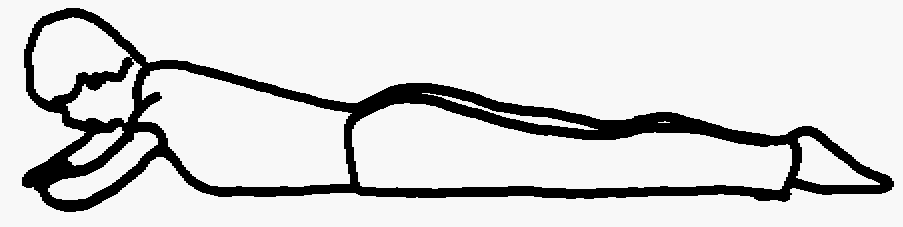
The Diamond Press:- Start Position
- Lie on your stomach with your feet hip width apart.
- Make a diamond shape with your arms by touching your finger tips together just under your forehead.
- Flare your shoulder blades outward toward your armpits.
The Diamond Press:- Action
- Exhale to lift your navel up toward your spine (like "melting upwards"
- Inhale to lift the head and upper chest
5 cm off the floor and gently tuck the chin while lenghtening the sides of the neck -
(from head to chest is the barrel of a canon pointing to the sky!)
- Exhale to lower you head back into your hands
(Scroll right>>>>....)
|
The Diamond Press:
|
Start Position

|
Action
|
What it does
- "Flare your shoulder blades" works the Serratus anterior, which is one of the "scapular anchor" muscles,
that is often weak.
- Correction of Humeral Anterior Glide: The Diamond press may cause
your shoulder to click or "graunch". Which is a good sign! - The head of the humerus bone is moving
backward in the shoulder joint to sit in its correct location. If you have
shoulder impingement pain, this exercise helps.
- Unrounds the upper spine - corrects kyphosis!
|
Comments
- Perfect antidote to staring into a computer screen!
- The scapular anchor is being worked with the arms
above the head and hands pushing "forward", which is a movement
not commonly used in every day life.
Watch Points
- Melt the navbel upward (10% effort) and grow yourself long!
- Keep looking down to your fingers!
Reference
- Shirley A Sahrmann: Diagnosis and Treatment of Movement Impairment Syndromes;
Publ. Mosby 2002
- The Official Body Control Pilates Manual Available from: http://www.bodycontrol.co.uk/
© Bruce Thomson, EasyVigour Project
scroll up^^^^.....
|