|
|
|---|
- Since this (and many pilates exercises) require sustained abdominal contraction
one should proceed with caution if one has high blood pressure or heart problems.
- Since this is performed lying on the back it is advised not to do this if one is more than
5 months pregnant.
- If the neck is sore do Hundred level 1 instead.
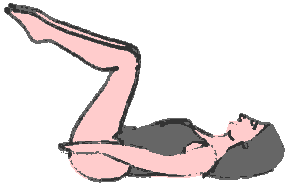
The Hundred (Level 3):- Start Position
- Lie on your back in the relaxation position.
- (Breathing out): Bring one knee up at a time to your chest.
- Pelvic neutral and Scapulas anchored.
- Roll your head from side to side.
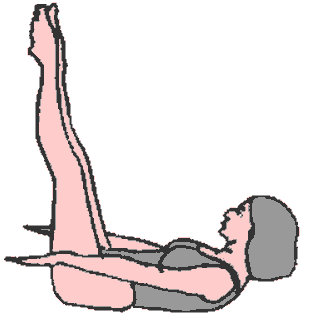
The Hundred (Level 3):- Action
- Breathe in and zip and hollow.
- (Breathing out): curl your chest up off the floor refer (PAC with Arms for details).
- Breathe in and then (beathing out): straighten your legs so that your toes
are softly pointing to the ceiling. Keep your legs close to vertical! -stops your lower back arching.
- (Breathing in and still zipping): Pump your arms up and down
for a count of five. Keep your scapulas anchored and fingers lengthening away.
- (Breathing out): pump your arms up and down for another count of five.
- Repeat steps four and five for a total of five to ten times.
(Scroll right>>>>....)
|
The Hundred (Level 3):
|
Action
|
Start Position
|
Comments
- This is the classic Pilates Hundred Exercise.
- Why One Hundred? - Because after ten inward and outward breath cycles, you
have pumped your hands up and down a total of 100 times!
- It used to be the warm up exercise for all Pilates mat classes.
|
What it does
- Emphasises lateral breathing (into the sides of your chest).
- Works the abdominals, and warms you up!
Watch Points
- Gently tuck your chin and keep the back of your long and neck relaxed. Refer
Chin Tucks. If there is neck strain, use the alternative
Hundred (level 1).
- Your breathing should be comfortable. Remember to breathe deeply into the sides of the
lower rib cage.
- Keep your breast bone soft and your upper chest open between the shoulders.
- Maintain the scapular anchor, and keep the tension in your arms and neck to a minimum.
- Keep the upper chest open.
Reference
- Shirley A Sahrmann: Diagnosis and Treatment of Movement Impairment Syndromes;
Publ. Mosby 2002
- The Official Body Control Pilates Manual Available from: http://www.bodycontrol.co.uk/
© Bruce Thomson, EasyVigour Project
scroll up^^^^.....
|