| ||||||||||
|---|---|---|---|---|---|---|---|---|---|---|
|
The students of FM Alexander (who developed the Alexander Technique) called it "Monkey"...
Monkey re-establishes the squat Chair sitting has robbed us of the latrine squat. The latrine (or any other) squat is back protective because it uses back protective muscles (Quads, buttocks & long muscles of the back (erector spinae). A regularly performed "monkey" strengthens these muscles & reduces sway back (refer picture). Monkey releases neck tension & pain Most people have "bad habit" muscle tension around the neck. This leads to shoulder & neck pain, headache and grumpiness. Monkey makes it easy(ish) to identify this "bad-habit" tension & release it. Activate the correct postural muscles & your neck feels safe. A safe neck can relax. This brings freedom from the waist all the way up to the crown of the head. It's not a treatment but it can massively reduce migraine and neck pain! Start position
|
Monkey action 2: exploring the squat
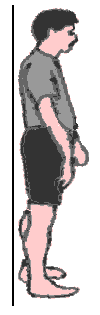
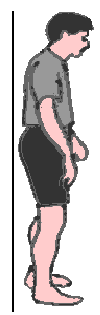
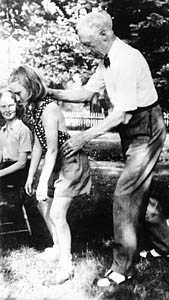
Left: Poor posture - chin jutting, shoulders rounded shoulder blades swayed back behind line of buttocks. Middle: Monkey has corrected the sway back, but the chin is still jutting, and the shoulders are still rounded. Right: FM Alexander & student explore a more released and lengthened arrangement of body parts.
|
 Listen to audio! R-R-L exercise for Monkey (3:30)
Positioning checklist Weight is equal between the balls of toes and heel. Weight on heel is on its centre. Knees go forward over second toe. Back is straight, lengthening; not tense. Hands hang from the shoulders like plumb lines. Release-Relax-Lengthen (R-R-L) exercises For the neck: Send the mid-back-of-neck backwards (this activates the neck stabilizer muscles). Release relax & lengthen from the side of the breast, to the mid collar bone and from the collar bone, to the mid-back-of-neck. Release relax & lengthen from the mid-back-of-neck to the base of the skull. You might feel your head lift forward and upwards "like a helium balloon". For the torso: Gently activate pelvic floor stabilizer muscles by folding the sit bones together - "squeeze a $20 dollar note". Gently activate tummy muscles by "work-the-stop-you-peeing-muscle" - feel the lower tummy firm and flatten. Release relax & lengthen from the bottom of the pelvic floor (where the rectum is) to the top of the nasal cavity (above the roof of the mouth). Grow yourself tall! For the shoulders and back of the neck: Release relax & lengthen from the bone behind the ear to the side of the neck and to the shoulders. Release relax & lengthen, again from the bone behind the ear, to the top of the shoulder blades. |
||||||||