Trigger Points: Sentinels for Mechanical Stress
So why do trigger points exist? - Trigger points are ubiquitous in both man and
animal. Both their locations in muscles and their patterns of transferred pain/inflammation
are remarkably similar between individuals. Such uniformity suggests that both the
trigger points and their patterns of referral are strongly encoded at the genetic
level; that they are in fact there for a purpose. What can that purpose be?
The most likely explanation runs thus:-
"Trigger points are sentinels for mechanical stress that warn the organism to
guard the likely associated parts, and at the same time initiate a cycle of acute
inflammation that is followed by healing and strengthening of likely associated parts".
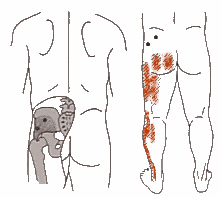
For example, the Gluteus minimus (diagram right) is a "side strut" for the
leg. If a trigger point in the Gluteus minimus senses that it is being over-loaded,
it is entirely appropriate for it to send a message to all of the "side-strut"
muscles and ligaments down the entire length of the leg to warn them to also strengthen up.
|
|
Diagram:
Trigger points in the Gluteus minimus have the potential, via referred pain
and referred neurogenic inflammation to bring about strengthening of the "side struts"
of the whole associated leg.
|
Trigger points become active subsequent to the following mechanical stressors:-
- Prolonged and/or heavy exertion.
- Mechanical irritation such as the prolonged pressure caused by sitting on a wallet.
- Trauma, either from a direct blow or from "pulling" a muscle.
All the above are examples of mechanical stress. In each situation, trigger points
initiate an integrated process designed to limit further damage and to bring about
healing and strengthening, thus:-
Initiation of the Guarding Response:
Tissues both near and far are "triggered" to send out pain warnings that encourage
the organism to take it easy, to not put too much pressure on the damaged part or
parts, to perhaps learn a wiser movement pattern.
Initiation of the Cycle of Repair and Strengthening:
Inflammation is triggered (by mechanical and neurogenic means locally see "taut band"
and by neurogenic means in referral zones, see "neurogenic inflammation"), and initiates the cycle
of tissue destruction followed by repair and strengthening that is the hallmark of
the self repairing biological machine. It is not just the locus of the trigger
point that attempts to inflame, then heal and strengthen: The referral phenomenon
means that muscles and tendons as far removed as the opposite ends of the affected
limb are "triggered" into an appropriate cycle of tissue inflammation followed by
repair and strengthening.
At least that is how it would be in a perfect world!
There is an objection to this hypothesis, which needs to be answered...
Trigger Points: when Initiation of Inflammation and Repair fails to switch off
If Trigger Points have such a beneficial
effect in terms of response to trauma, how come so many people are afflicted with
chronic trigger point induced pain and disability? - The answer lies in that word
"chronic": Trigger points should only remain active for a period of perhaps one
to three days. After that, the trigger points should "down-regulate"; pain enforced
rest should be replaced by resumed activity, and trigger point triggered acute
inflammation should progress to the chronic repair and strengthening phase.
The following two sections explain why this may down-regulation may not readily occur.
Biology of Trigger Points: Sentinels for Mechanical Stress
Return to top...
Biology of trigger points: Sentinels for Mechanical Stress
© Bruce Thomson, EasyVigour Project
|
|
You can do a lot about Trigger Points!
(book reviews,click here):-
Triggerpoints & Trigger Point Book Reviews
|
|