(3)
Chair Sitting:-
Arduous Exercise for certain postural control muscles!
When you sit in a standard chair, some important postural control muscles are inactivated, while
others are being asked to work overtime. This article discusses the link between lower
back pain and the following muscle problems:-
- Shortening of the hamstring muscle.
- Overworking of the Erector Spinae muscle group and the development of trigger points.
- Overworking of the Iliopsoas muscle group and the development of trigger points.
Hamstring Muscle Shortening
During office chair sitting, the hamstring muscles are inactive, and are held at a shortened length.
This is the probable cause of tight hamstrings. Tight hamstrings usually start at the age of 5 or
6 when children start their seated school careers(10).
Tight hamstrings are certainly very common. For example, a Google internet search will return 39,300 offerings
on the search "tight hamstrings".
The Back Maintenance Manual - for Lower Back Pain
Learn more!

|
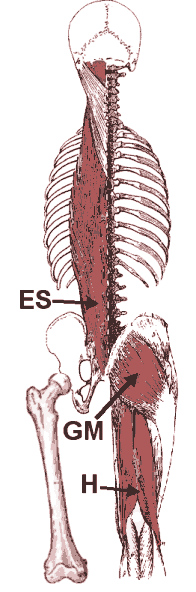
Diagram Below:- The Hamstrings (H)are shortened by sitting. Also, during sitting,
the Gluteus maximus (GM) is relaxed and unable
to tension the lumbosacral fascia. The Erector Spinae (ES) muscle group must therefore perform the entire
lumbar extension workload.
|
|
|
Tight hamstrings are associated with back pain(10). The reason is that tight hamstrings
stop the hips from flexing during forward bending.
That forces the lower back to bend beyond its strong middle range.
Tight hamstrings are also associated with Scheuermanns kyphosis in the active stages(9). There could
be two reasons for this. One is that excessive sitting in poorly designed school chairs is to blame for
both Scheuermanns and hamstring tightness. The other reason is the forward bending argument described in the
previous page.
Overworking of the Erector Spinae muscle group and trigger points.
Chair sitting is unique in that Gluteus maximi are totally relaxed at the same time
as having an upright torso, and they are therefore not able to contribute to lumbar extension and
back stabilization as they usually do (7).
Without the help of the Gluteal muscles, the Erector Spinae muscles
(see picture above) above become tired and painful in a very short time, and give up fighting to
maintain the correct "hollow" in the lumbar spine(2).
|
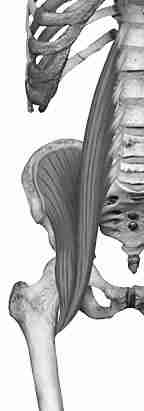
Diagram: The Iliopsoas Muscle Group. 10 to 15 percent of back pain patients have Trigger point problems in this,
the major hip flexor muscle group(8).
|
The table below shows the relationship between force of muscle contraction and time to muscle exhaustion.
It gives you a good understanding about how an apparently restful posture (such as office chair sitting)
is actually an intense workout for the Erector Spinae and the Iliopsoas muscle groups.
Table: How long does it take for a muscles to tire?
| Force of Muscle Contraction |
Time to Muscle Exhaustion |
| Maximum Force: |
One second |
| 70 Percent Force: |
30 seconds |
| 50 Percent Force: |
One minute |
| 8 Percent Force |
One hour |
| 3 Percent Force |
8 hours |
From the above table, it is not hard to work out that your Erector Spinae muscles are likely to be overworked,
and trigger points are likely to develop. (Please see comments
re: trigger points in the section on the iliopsoas muscle below, also see reference no. 11 below). If you have a one sided back pain, then having
a therapeutic massager look for a painful trigger point in the Erector Spinae Muscle is definitely worthwhile,
as are gentle side bending exercises such as the "Saturday Night Fever".
Iliopsoas Muscle Strain and Trigger Points
Assuming you are not using a full and appropriately shaped chair back, your Iliopsoas muscles must
pull your torso forward to stop you falling backward, and they have to do that at the
short end of their range of contractile length. (diagram of Iliopsoas muscle - see above).
That is a sure fire recipe for Iliopsoas muscle shortening and development of trigger points.
If you combine an intensive office chair sitting routine with a vigorously competitive sporting hobby,
then expect problems!
Ten to fifteen percent of back pain has an Iliopsoas trigger point component(8).
Iliopsoas trigger points are not recognised by many therapists, so here are some symptoms:
- Diffuse achy- type pain radiating out from the groin area to the lower back, and possibly around to the side
of the hip and the butt area. If the trigger points in the groin are not pressed, the pain is not sharp or stabbing.
- Relief of pain is often experienced by sitting down.
- Worse upon lengthening the iliopsoas, ie. when one stands up, or straightens the hip joint.
- Worse for doing situps.
- Worsened by externally rotating the hip (i.e. making the knee cap look outward) when the hip joint
is fully extended.
- In patients with siatic nerve pain, lying flat on one's back with the legs out straight causes the trigger point tightened
iliopsoas to compress the lumbar vertebrae together, with the result that the nerve roots of the siatic nerve are compressed too.
- When lying flat on one's back, doing a straight leg raise reveals weakness on the affected side.
- As with any trigger point, when a knowledgeable therapist applies pressure to the trigger point "knot"
in the muscle, the pain is severe: "If the iliopsoas muscle is in spasm the patient will jump off the table.
Believe me, it's that painful"(8).
- In patients with siatic nerve pain due to nerve root compression, lying flat on one's back with legs out straight stretches that trigger point tightened
iliopsoas. The result is that the iliopsoas compresses the lumbar vertebrae together, and the the nerve roots of the siatic nerve are compressed at the same time.
Treatment is therapeutic massage of the iliopsoas (ref 11, see also Triggerpoint Therapy Workbook). It is painful but effective.
You need to stretch too and exercise too. See:-
- Assisted Heal Slide. A deceptively "simple" iliopsoas stretch & exercise
- The Sir Galahad - designed
for the Rectus femoris, but also useful for the Iliopsoas muscle group.
- "The Itchy Shin" - a specific iliopsoas strengthening exercise.
Final Comment on Muscle Movement and Blood Flow
We have already argued that you need to move in order to "feed your discs".
The same applies to your muscles.
When a muscle contracts, the increased tension shuts off its blood supply.
It requires a period of relaxation for the blood supply to return.
The contraction-relaxation cycle therefore acts like a pump, and is in fact able to increase blood flow by a factor of
10 to 20 times (10).
During stationary activity such as chair sitting, the blood-muscle pump is not working.
At 60% of maximal contraction of the erector spinae muscle group, the blood flow is stopped (11).
Small wonder that you are fidgeting, slumping into lumbar flexion and loosing work efficiency
within an hour of starting your desk bound task (Bhatnagar et al 1985, quoted in ref. 2).
Summary
Office chair sitting has major back pain related consequences:-
- Tight hamstrings
- Iliopsoas trigger points
- Erector Spinae muscle fatigue
Answers Please??!!
So we have established that office chair sitting is an occupation with dangerous consequences!
What then is the answer?
- Can we avoid or modify our chair sitting routines?
- What sort of stretch and exercise pauses are ideal?
- Is there a single chair shape or strategy?
To be continued.
There are excellent recommendations in the pipe line but "Rome wasn't built in a day"
Please be patient and book mark this page for future updates....
|
References:-
- Deursen van LLJM Low back pain and everyday activities Thesis Erasmus
Universiteit Rotterdam ISBN 90-9017227-0 © 2003,
- Rani Lueder: Ergonomics of Seated Movement a Review of the Scientific Literature
Considerations relevant to the sum chair, Jun 2004.
- Spondylolisthesis: Article located at:-
http://www.healingwell.com/medcenter/spondylolisthesis.asp
- Mcgill SM, Norman RW, Yingling VR, Wells RP, Neumann P: Shear Happens!
Suggested guidelines for ergonomists to reduce the risk
of low back injury from shear loading
Article located at:- http://www.ergonomics.uwaterloo.ca/library/McG_etal-HFAC98.PDF
- Shirley A Sahrmann: Diagnosis and Treatment of Movement Impairment Syndromes; Publ. Waht Mosby 2002
- Taylor JR, Scott JE, Cribb AM, Bosworth TR: J Anat. 1992 ( Pt 1):137-4
1
- Bruce Thomson (2003): Engage Gluteus maximus!
- Kenneth Rich: The Iliopsoas Muscle -- The Great [Back Pain] Pretender.
Article located at: http://www.chiroweb.com/archives/15/05/24.html
- Fisk JW, Baigent ML, Jill PD: Scheurmanns Disease - A Clinical and Radiological Survey of 17
and 18 year olds", Amercian Journal of Physical Medicine, 63, 18-30,1984
- Wilson A:Are you Sitting Comfortably? - A self-Help Guide for Sufferers of Back Pain,
Neck Strain, Headaches, RSI, and other Associated Problems. Publ. Random House, London 1994
ISBN 0 356 21060 X
- McGill, S.M., Hughson and Parks, K. (2000) Lumbar erector spinae oxygenation
during prolonged contractions: Implications for prolonged work. ERGONOMICS 43: 486-493.
- Davies C, Davies A, Simons DG: The Triggerpoint Therapy Workbook: Your Self-Treatment Guide for Pain
Relief, Second Edition. (See page 144 - Iliopsoas).

Consequences of Office Chair Sitting(3): Tight Hamstrings, Iliopsoas Trigger Points,
Erector Spinae Muscle Fatigue.
© Bruce Thomson, EasyVigour Project
Chair Sitting 1 | Chair Sitting 2 |
Chair Sitting 3
Return to top...
|
|
|
|