Is the base of your sitting spine being asked to flex or extend?
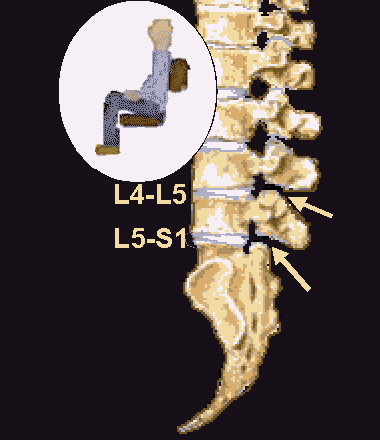
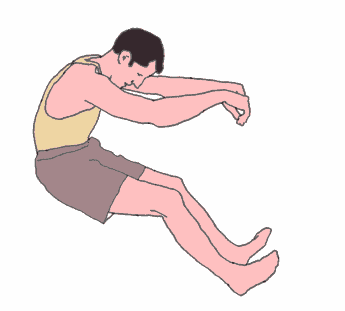
- If you are too tall for your seat, sitting in the standard office chair has you
flexing your discs (L4-L5 and L5-S1) to excess
(see middle diagram below).
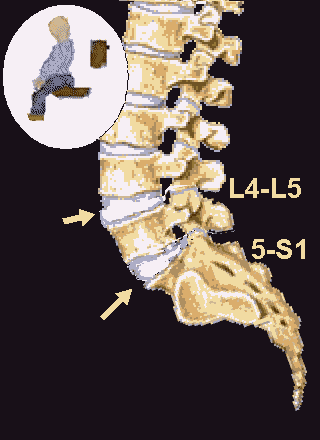
- If you are a short person (possibly with a large abdomen), sitting
in the standard office chair has you extending your discs (L4-L5 and L5-S1) to excess (see
right hand diagram below).
- Add to this the possibility that you are constantly twisting in your chair to
open a file cabinet to your side or to pick up a phone on the table behind you,
and you have a recipe for back pain disaster!
The immediate effects, which happen as long as you are seated, are depicted in the table below.
|
The Back Maintenance Manual - for Lower Back Pain
Learn more!

|
Table: Immediate Effects of Office Chair Sitting on the Lumbar Spine
|
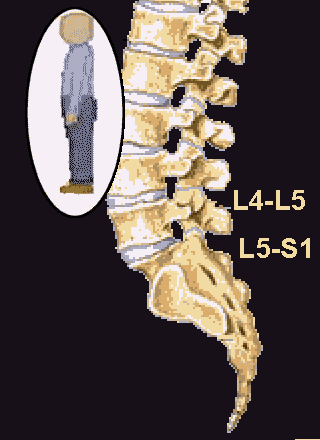
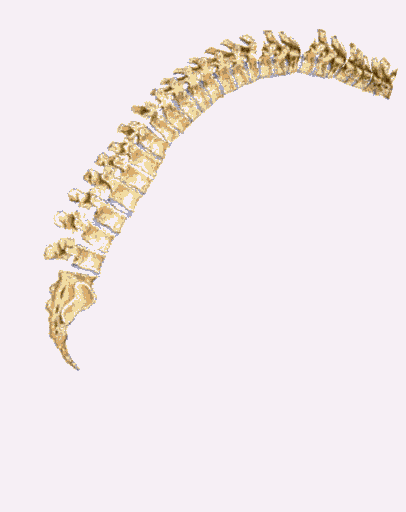
Picture of the Standing
Spine.
Note the Normal Lumbar Curve. This spine is in balance with the weight spread
evenly over the whole surface of the disc and facet joints.
|
Picture of the tall person's spine while office chair sitting.
Lumbar flexion has occurred at the Lowest Intervertebral Joints
(L4-L5 and L5-S1).
The discs are opened and stretched toward the back, and this habitual positioning makes
the discs weakest at the point where they are most likely to rupture.
|
Picture of short person's spine while office chair sitting.
Note the extra curve at
the base of the spine. Lumbar extension has occurred at L4-L5 and L5-S1.
The facet joints are being compressed together at the back, and the siatic nerve may be
pinched.
|
|
|
|
These immediate effects carry over into your none chair sitting activities. Consider:
- "When a system is multi-segmented...
the greatest degree of motion occurs at the most flexible segment(5)".
So if the base of your spine is used to being flexed (very tall person), or the base of
your spine is used to being extended (short person), these movement patterns will carry over
into your none-chair sitting activities as well.
The rest of this article discusses firstly the damage likely to occur to your
"flex-habituated" lumbar spine, and
secondly damage to your "extension-habituated" lumbar spine.
Damage to your "Flex-Habituated" Lumbar Spine
L4-L5 and L5-S1 (the two lowest discs in
the spine), are the lumbar discs most likely to herniate. In fact,
90% of lumbar herniation occurs at L4-L5 and L5-S1! If you habitually put them into flexion or into extension,
if you add to that a twisting motion - You are in big trouble! Keep in mind:-
People who sit a lot have trained the lower lumbar spine (joints L4-L5 and L5-S1) to be
that "most flexible segment" for forward bending.
The three directions of force that can injure a "pre-flexed" intervertebral joint
will be discussed in greater detail:-
- Over flexing of the Lower Spine
- Anterior Shear of the Lower Spine
- Twisting/Side Bend of the Lower Spine
|
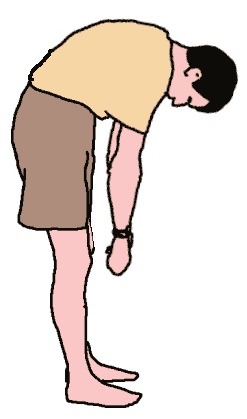
(1) Over flexing of the Lower Spine.
The forward bending subject in the diagram to the right - typically a middle aged man
who spends a lot of time in slumped chair sitting - has his spine bent at the lower lumbar region (L4-L5, and L5-S1)
(and also at the lower thoracic region). The torso of this man has
adopted the same shape as that of a chair sitting man slumped down into his chair. The lowest two discs are being
taken to their flexed extremes. Now ask this man to pick up a heavy carton... Lumbar herniation and pinched
siatic nerve (or siatic nerve root to be precise) is a certainty!
|
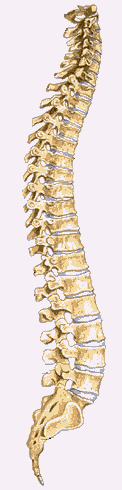
Diagrams illustrate the forward bend of an habitually chair sitting man.
Note the increased flexion just below the waist (the point of origin of the siatic nerve),
and also the excessive flex (kyphosis) of the lower chest region.
|
 |
 |
 |
|
|
|
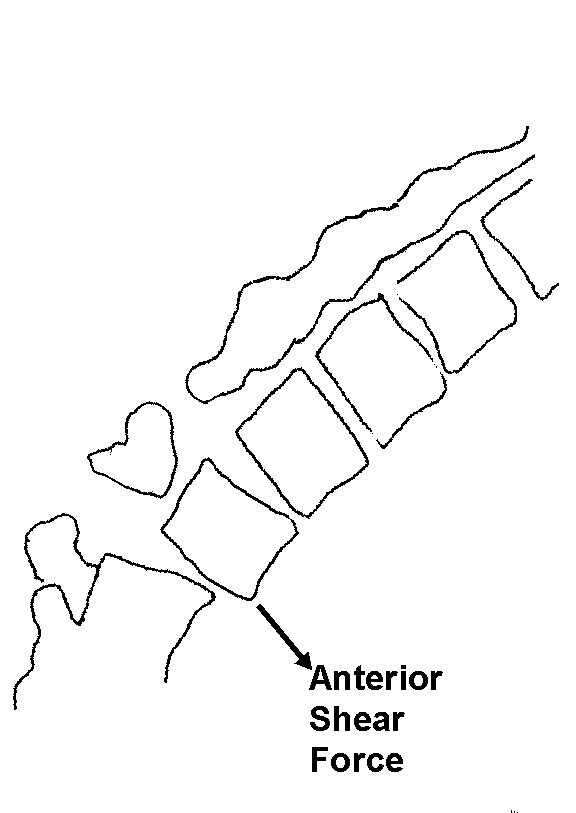
(2) Anterior Shear Force on the Lower Spine
Anterior shear is when a vertebra slips forward of the vertebra (or the sacrum) immediately below
it (diagram of anterior shear, see below). (Like disc herniation, most anterior shear happens at
L4-L5 and L5-S1). There is minimal anterior shear force while sitting, but sitting does train the
low lumbar spine to go easily into flexion. And here is the connection: it takes as little as one fifth
of the anterior shear force to damage the flexed intervertebral joint as compared with the same
joint in neutral(4). The habitual chair sitter who carries his "chair sitter" lumbar flexion tendency
with him during a "fall onto the buttock" (see diagram) may thus be up to five times more likely to
sustain damage(4). For example, from my own experience, while I have good posture movement
awareness, I am still using a standard office chair while sitting at the computer.
|
| That this is not
beneficial was recently highlighted to me when I sustained a short bout of low lumbar back pain
after falling backwards onto my rear end (playing soccer with a two year old child can be as
dangerous as mixing it with the big boys). The movement easily pushed the “chair pre-flexed”
discs into hyper-flexion, presumably allowing a jarring anterior shear force to do its damage. My
pain was not evident until 48 hours later, and the modified
McKenzie lumbar extension exercise
proved effective in reducing symptoms such that I was free of pain in 2 weeks, but it
was a lesson worth learning. Chair sitting sets a tall person up for L4-L5 and L5-S1 disc
injury related to anterior shear! Herniate the disc, and Siatic Nerve pain will follow! (Symptoms of siatic nerve pain, ref:
Lumbar Herniation and Siatic Nerve Pain) |
Diagrams illustrating Anterior Shear Force on the flexed lumbar spine of a person
sustaining a backward fall onto the buttock. Note: While anterior shear force can
do painful damage to the flexed lumbar
spine, actual visible anterior slippage on plain x-ray images is not likely to be seen. You need fractures or
developmental defects in the vertebra close to the facet joints (spondylolysis) for
anterior slippage (sponylolisthesis) to occur.
 |
|
|
|
(3) Dangerous rotation/side-bending!
As already discussed and depicted (see chair sitting spine diagram above), the facet joints of a flexed spine are
pulled open. That means they cannot lock together and therefore cannot aid the lumbar discs in resisting
twisting and side bending. You can try this for yourself as you sit in your chair
(be especially slow and careful about this exercise if you have low back pain or siatic nerve pinching):-
Posture-Movement Awareness Exercise:
"Your lumbar spine bends further to the side when it is flexed than when it is straight".
- Lock your facet joints by extending your back so that there is a strong hollow
in your lower back (see picture of standing spine above).
Now bend to the side, and estimate how far you can bend to the side in this
lumbar-extended position (it may be about 15 degrees).
- Now unlock your facet joints by flexing so that there is a strong
curve in your lower back (see picture of sitting spine above),
and bend to the side. Estimate how far you can bend to the side in
this lumbar-flexed position (it may be about 30 degrees).
(You can do the same exercise, but this time try twisting instead of bending to
one side. You will only notice a small difference when twisting.
The reason for this is that "twisting" movements are mostly handled by the spine at the level of the lower chest,
which was not the area that you were consciously trying to flex).
At any rate, habitually moving your
lower back into extremes of rotation or twisting is especially damaging in terms of disc damage and
pinched siatic nerve pain. For
example: you sit directly in front of your computer, but you have to reach behind you to answer
your phone; you constantly open a file cabinet to the left of your desk;
people are constantly opening a door to your right to interrupt you.
You are under pressure, and you are forgetting to maintain a neutral curve in your spine (similar to your standing
curve)....
In short you are suffering a prolonged and damaging onslaught to your spinal health. You will
definitely damage your lumbar disks, with a high likelihood of disc herniation and siatic nerve pinching(5)!
Damage to your "Extension-habituated" Lumbar Spine
|
|
A spine that is posturally balanced puts about 67% of load on the disc, and about 33% of
load onto the facet joints (see diagram right).
If the base of your spine has been held in extension by long periods of chair sitting,
it will tend to hold that position throughout the rest of the day. Excessive spinal extension
puts excessive load on the facet joints. This excessive loading will hasten the onset of arthritis
(leads to facet syndrome) and the laying down of new bone within the spinal canal
(spinal stenosis or narrowing). With either condition, the result is pain, especially when the habitually
extended spine is twisted. (Similar to the twisting that is described above,
except that the damage shifts to the facet joint area of the spine.
|
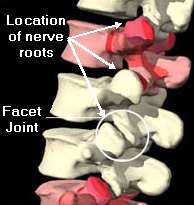
Diagram: Pinched Siatic Nerve Root is a Consequence of "Facet Syndrome" -
Facet Joints are in close Proximity to the Spinal Nerve Roots.
When a facet joint becomes inflamed, it presses on the nerve root and causes pain.
|
Summary...
Now that you know that a spine in neutral is at its most stable, you can appreciate why you should
try to maintain your spine around that neutral positioning during office chair sitting.
For more information on disc herniation and symptoms of siatic nerve damage, refer to:-
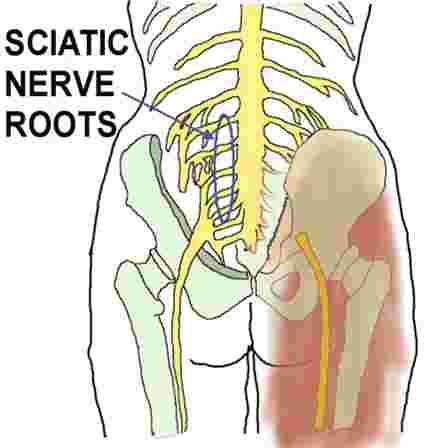
Pictures, Diagrams, Symptoms: Cauda equina and Siatic nerve Damage.
|
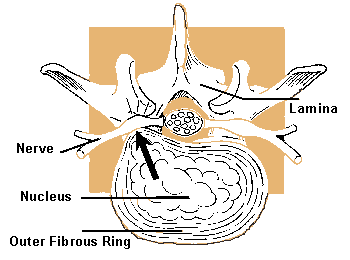
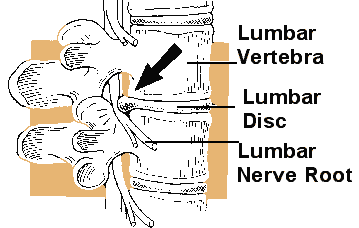
Diagrams: Pinched Siatic Nerve Root is a Consequence of Disc Prolapse.
The Siatic Nerve pinching is arrowed.
|

Office Chair Sitting: Page 1 | Page 2 |
Page 3
Consequences of Office Chair Sitting (2):
Pre-flexed Spine and pinched Siatic Nerve Pain!
© Bruce Thomson, EasyVigour Project
Return to top...
|
|
|